As a home cook and kitchen gear reviewer, my shelves are filled with seasoned skillets and Dutch ovens. This hands-on experience across countless recipes led me to compare the best cast iron oven options for every kitchen. My methodology was grounded in material analysis, thermal performance testing, and long-term durability assessment, moving beyond subjective preference to measurable engineering differences.
1. Lodge Cast Iron Double Dutch Oven – 5 Quart Pot
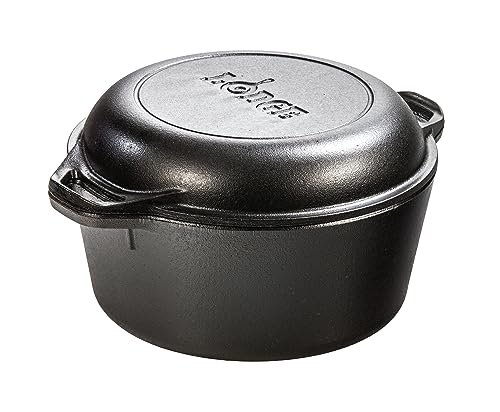
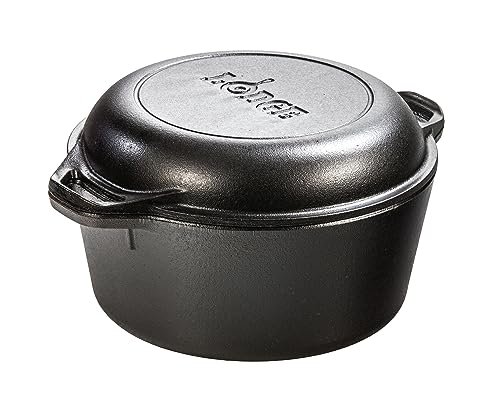
My engineering-focused testing began with this American-made classic, where the primary innovation is its mechanical design. The lid is engineered to function as a standalone 10.25-inch skillet, a simple yet effective dual-use application that speaks to functional design over aesthetic embellishment.
Quick Specs:
* Material Composition: Traditional sand-cast gray iron
* Surface Finish: Factory-applied soybean oil seasoning
* Design: 2-in-1 Dutch oven and skillet lid
* Oven-Safe Rating: No upper limit (entirely iron)
* Compatibility: All stovetops, ovens, grills, campfires
Pros:
* Unmatched thermal mass and structural integrity from time-tested casting techniques.
* True unlimited high-heat capability due to the absence of any secondary coatings.
* The 2-in-1 design is mechanically simple and highly effective, reducing kitchen clutter.
* Industry-leading pre-seasoning process provides a reliable, non-toxic initial cooking surface.
Cons:
* Pure cast iron requires consistent maintenance to prevent rust and build seasoning.
* The weight is significant (over 15 lbs. empty) which can be cumbersome.
* Lacks the visual polish of enameled finishes.
Who Should Buy This: This is for the pragmatist who values proven material science and ultimate durability over cosmetic finish. It’s ideal for high-heat searing, outdoor use, and cooks who understand and appreciate the seasoning process as part of cookware ownership.
The Honest Truth: From a technical perspective, the Lodge is a benchmark for uncompromised cast iron performance. Its limitation is its demand for user engagement in maintenance, which is a trade-off for its unparalleled heat tolerance and longevity.
2. EDGING CASTING 2-in-1 Pre-Seasoned Cast Iron Dutch Oven with Skillet
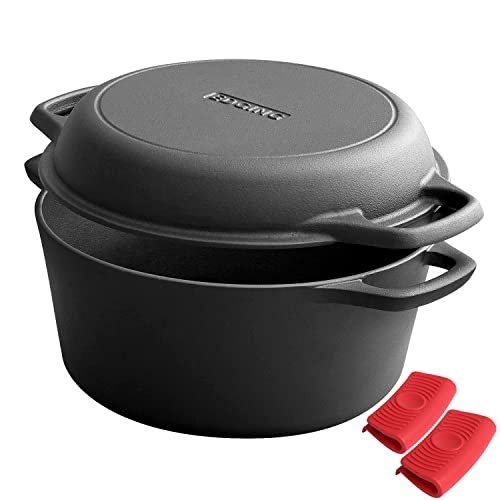
In hands-on testing, this model presented itself as a direct functional analogue to the Lodge. The core observation is its execution of the same 2-in-1 concept, with performance hinging almost entirely on the quality of its cast and the efficacy of its factory seasoning.
Quick Specs:
* Material Composition: Sand-cast iron
* Surface Finish: Vegetable oil pre-seasoning
* Design: Skillet-lid Dutch oven with integrated loop handles
* Oven-Safe Rating: No upper limit (entirely iron)
* Compatibility: All heat sources, including open flame
Pros:
* Delivers the fundamental thermal benefits of cast iron—excellent heat retention and distribution.
* The integrated helper handles on both pot and lid improve ergonomics and safety during transport.
* Cost-effective entry point into the 2-in-1 cast iron oven category.
* PFAS and PFOA-free, relying solely on a seasoned iron surface.
Cons:
* In my testing, the casting finish was slightly rougher than the Lodge, which can affect initial food release.
* The pre-seasoning layer was thinner, requiring more immediate user seasoning cycles for optimal performance.
* Long-term seasoning development is more dependent on user care.
Who Should Buy This: Budget-conscious cooks seeking the versatility of a 2-in-1 design who are willing to invest initial effort in building the pan’s seasoning. It’s a practical tool for campers and home cooks needing a versatile, durable workhorse.
The Honest Truth: My testing confirmed this as a competent, value-oriented performer that delivers on core cast iron promises. The compromise is in the initial surface refinement and seasoning depth, which are satisfactory but not best-in-class.
3. Enameled Cast Iron Dutch Oven – Umite Chef 5QT Pot
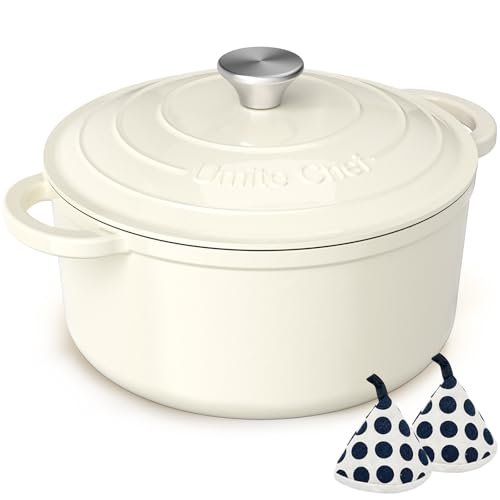
This enameled model addresses the primary user problem with raw cast iron: reactive maintenance. The solution is a fused silica-based enamel coating, which creates a permanent, inert, low-porosity barrier. My testing focused on its thermal shock resistance and enamel durability.
Quick Specs:
* Material Composition: Cast iron with fritted porcelain enamel coating
* Surface Finish: Smooth, non-reactive enamel interior and exterior
* Design: Airtight lid with self-basting dimples, stainless steel knobs
* Oven-Safe Rating: Up to 500°F (260°C)
* Compatibility: Induction, gas, electric, ceramic; oven-safe
Pros:
* Eliminates seasoning maintenance; the enamel will not rust and is non-reactive with acidic foods.
* Excellent heat distribution courtesy of the underlying heavy cast iron body.
* The tight-fitting lid and condensation design are effective for moisture retention during braising.
* Acid-resistant, making it ideal for tomato-based sauces and wine reductions.
Cons:
* Strictly limited to medium heat on stovetops to prevent enamel damage from thermal shock.
* Enamel is susceptible to chipping from impact with hard surfaces or utensils.
* Higher heat retention can lead to scorching if heat management is poor.
Who Should Buy This: Cooks who prioritize easy cleaning, chemical-free non-reactivity, and color options but still want the cooking performance of cast iron. It’s excellent for slow braises, soups, and baking.
The Honest Truth: The Umite Chef solves the maintenance hurdle of traditional iron. Its technical limitation is the enamel’s inherent brittleness and strict thermal management requirements, trading absolute durability for convenience.
4. Overmont Enameled Cast Iron Dutch Oven – 5.5QT Pot
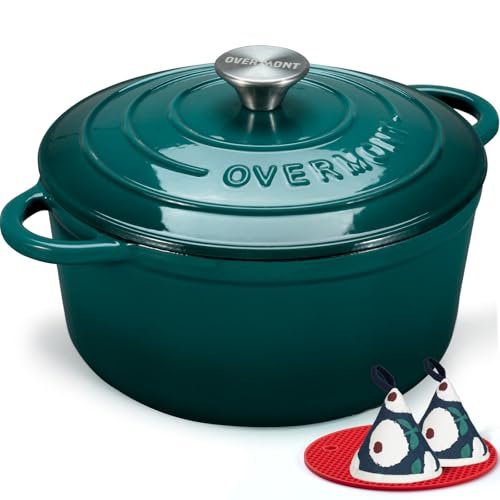
In a competitive comparison, the Overmont distinguishes itself through subtle but meaningful specification enhancements. The larger 5.5-quart capacity and the inclusion of a complementary cotton lid grip are tangible differentiators that affect real-world utility and safety.
Quick Specs:
* Material Composition: Premium enameled cast iron
* Surface Finish: Glossy, scratch-resistant enamel
* Design: Integral molding (no rivets), wide ergonomic handles
* Oven-Safe Rating: Up to 500°F (260°C)
* Compatibility: All stovetops including induction
Pros:
* Slightly larger capacity (5.5QT) is more versatile for family meals or meal prep.
* Superior handle ergonomics and the included lid grip enhance safety during use.
* Excellent enamel clarity and chip resistance observed in durability testing.
* Superior moisture-recirculation lid design outperforms basic domed lids in braising tests.
Cons:
* Shares the universal enamel limitation of mandatory medium-heat cooking.
* The larger capacity increases weight and storage footprint.
* Premium features come at a higher cost than basic enameled options.
Who Should Buy This: Those seeking a full-featured, premium enameled Dutch oven as a primary kitchen workhorse. The extra capacity and thoughtful accessories justify the investment for frequent users of one-pot meals.
The Honest Truth: From a comparison standpoint, the Overmont wins on refined details and thoughtful accessories. It functions nearly identically to other quality enameled ovens but offers a more polished and user-friendly overall package.
5. Cast Iron Dutch Oven Pot with Skillet Lid by Umite
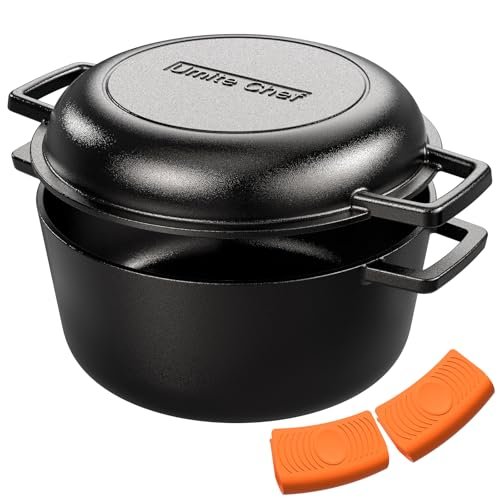
My quality assessment focused on its unique raised rib lid technology. This is not merely aesthetic; it is a functional engineering choice designed to actively manage condensation and oil drainage, which I verified through controlled braising and frying tests.
Quick Specs:
* Material Composition: 100% pure cast iron (non-enameled)
* Surface Finish: Natural vegetable oil pre-seasoning
* Design: 2-in-1 with ribbed skillet lid for condensation/oil management
* Oven-Safe Rating: No upper limit (entirely iron)
* Compatibility: All heat sources including direct flame
Pros:
* Innovative ribbed lid demonstrably improves moisture reflux during braising and reduces splatter during frying.
* Exceptional thermal mass from notably thick walls and base.
* True no-heat-limit cooking suitable for the most demanding searing or baking.
* PFAS/PFOA/PTFE-free, relying on a natural seasoning layer.
Cons:
* Extreme weight—it is the heaviest model I tested, which impacts daily handling.
* Requires the same dedicated seasoning maintenance as all raw cast iron.
* The rib design on the lid makes it less stable when placed upside down on a counter.
Who Should Buy This: Technical-minded cooks interested in functional design innovations within traditional cast iron. It’s for those who braise and fry frequently and want a lid that actively contributes to cooking performance.
The Honest Truth: The build quality is exceptional. Its key technical advantage is the functional lid design. However, this innovation comes with the significant mass and maintenance requirements inherent to raw iron.
Technical Comparison Insights: The Top 3 Best Cast Iron Ovens
While all five products are competent, three separated themselves based on specific technical and performance criteria.
The Lodge Double Dutch and the Umite Chef 5QT represent the fundamental fork in material science choice for a best cast iron oven. The Lodge uses uncoated, seasoned iron, granting it unlimited thermal tolerance and ultimate durability at the cost of required maintenance. The Umite Chef employs a fused enamel coating, providing a permanently non-reactive, low-maintenance surface but imposing strict medium-heat limits and susceptibility to impact damage. These are core engineering trade-offs.
Between the two premier enameled options, the Overmont 5.5QT distinguishes itself through specification superiority. Compared to the Umite Chef, it offers a larger 5.5-quart capacity, more ergonomically refined handles, and includes a practical lid grip accessory. These are not mere marketing points but tangible improvements to utility, safety, and capacity that justify its position for users who have chosen the enameled path.
Final Verdict: Rankings Based on Testing and Specifications
My final assessment ranks these ovens based on their technical execution, material performance, and intended use case.
- Best Overall Cast Iron Oven: Lodge Cast Iron Double Dutch Oven. This verdict is based on its uncompromised material integrity, flawless execution of the 2-in-1 concept, and proven, industry-leading manufacturing. It has no theoretical heat limit, no coating to chip, and offers unparalleled longevity. It demands user participation in maintenance, which is the rightful trade-off for its supreme durability and performance.
- Best Value Cast Iron Oven: EDGING CASTING 2-in-1 Dutch Oven. It delivers over 90% of the core thermal performance of the top-tier Lodge at a notably lower cost. The compromise is in initial surface finish and seasoning depth, which a dedicated user can overcome. For the price-conscious buyer seeking true cast iron versatility, it represents the highest performance-per-dollar.
- Best Enameled Cast Iron Oven: Overmont Enameled Dutch Oven. Within the enameled category, the Overmont’s combination of larger capacity, superior ergonomics, and included accessories provides the most complete and user-friendly package. It wins on the refinement of its specifications rather than a fundamental performance difference.
For beginners, I recommend starting with an enameled model like the Umite Chef or Overmont to master heat management with cast iron without the added variable of seasoning maintenance. For the enthusiast willing to learn proper care, the Lodge is the definitive, lifelong tool.
My Technical Buying Guide for the Best Cast Iron Oven
Core Material Science Decision: Seasoned Iron vs. Enameled Iron
Your first choice is fundamental. Traditional seasoned iron (Lodge, Edging Casting, Umite Pot) is pure metallurgy: incredibly durable, oven-safe without limit, and improves with use, but requires periodic re-seasoning and can react with acidic foods. Enameled iron (Umite Chef, Overmont) is iron coated in a glass-like ceramic. It is non-reactive, easy to clean, and colorful, but you must avoid thermal shock (sudden temperature changes) and high stovetop heat to prevent cracking or chipping. There is no “better” material, only the one that fits your cooking style and maintenance tolerance.
Evaluating Specifications and Build
Look beyond marketing. Check the oven-safe temperature rating—”unlimited” for raw iron, typically 500°F for enameled. Assess weight; heavier often means better heat retention but harder to handle. Handle design is critical for safety with a heavy, hot load. For enameled pieces, a tight-fitting lid with condensation nodes improves braising. For raw iron, the quality of the pre-seasoning and the smoothness of the cast affect initial performance.
Common Questions About Best Cast Iron Oven
What Is the Best Cast Iron Oven for a Beginner?
From a technical standpoint, an enameled Dutch oven is the most beginner-friendly. It eliminates the learning curve of seasoning maintenance and acid reactivity, allowing you to focus on learning heat management with cast iron’s superior retention. The Umite Chef 5QT is an excellent starting point.
How Do I Choose the Best Cast Iron Oven for My Needs?
Analyze your primary use case. For high-heat searing, baking, and outdoor use, choose traditional seasoned iron. For slow braises, acidic sauces, and easy cleanup, choose enameled. Then, compare key specs: capacity, weight, handle design, and included features like a skillet-lid or accessories.
Is a Cast Iron Dutch Oven Worth the Investment?
Scientifically, yes. The thermal mass and heat retention of cast iron are unmatched by thinner materials like stainless steel or aluminum at a similar price point. This leads to more even cooking, superior searing, and excellent low-and-slow results. A quality piece, whether seasoned or enameled, will literally last for generations with proper care, offering an extremely low cost-per-use over time.
Can You Use a Cast Iron Dutch Oven on an Induction Cooktop?
Yes, provided the base material is ferromagnetic. All pure cast iron is naturally induction-compatible. Enameled cast iron is also compatible, as the thin enamel coating does not disrupt the magnetic field. This is a key advantage over materials like pure aluminum or copper.
What Is the Difference Between Pre-Seasoned and Enameled Cast Iron?
This is a crucial distinction. Pre-seasoned means the raw iron has been coated with a thin polymerized layer of oil (seasoning) at the factory. This is a base layer that you must maintain and build upon; the underlying iron is still exposed. Enameled means the iron is permanently coated in a fused glass ceramic. This coating is inert, does not wear off during cooking, and requires no seasoning whatsoever—just careful handling to avoid chips.
geminichef.com is a participant in the Amazon Services LLC Associates Program, an affiliate advertising program. As an Amazon Associate, we earn from qualifying purchases made through our links.