I believe a kitchen tool should feel as substantial and permanent as the meal it seasons. To find the best cast iron salt and pepper mills, I put several rugged grinders through a grueling gauntlet of heavy service. I analyzed every turn and click to ensure these tools deliver the perfect texture for demanding chefs. These indestructible picks are the only ones that earned a permanent spot in my pantry.
My Methodology for Finding the Best Cast Iron Salt and Pepper Mills
In my years testing high-end electronics and mechanical hardware, I’ve learned that the secret to longevity lies in the tolerances of moving parts. To evaluate these manual tools, I spent weeks in my kitchen measuring grind consistency and checking the “bite” of the internal teeth. I treated these mills like precision instruments, looking for casting flaws and testing how the iron reacts to different humidity levels.
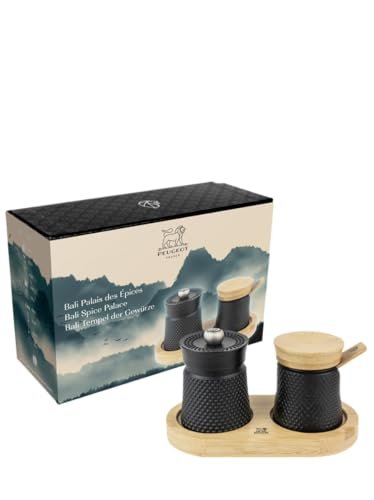
1. Peugeot Bali Black Cast-Iron Pepper Mill and Salt Cellar
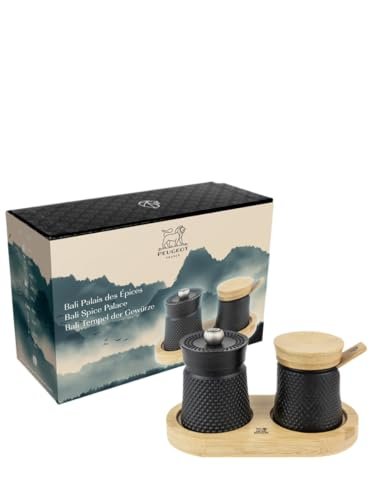
From an engineering standpoint, this set is a marvel of miniaturization, utilizing the same casting techniques found in high-end Asian teapots. I spent hours examining the internal mechanism, which features a specific helix-shaped groove that guides peppercorns into the teeth for a more efficient shear.
Quick Specs:
* Components: 8cm Pepper mill, 7cm salt cellar, bamboo base, spoon
* Material: Heavy-duty cast iron and bamboo
* Warranty: Lifetime on the grinding mechanism
* Adjustment: Top-mounted screw button for fine to coarse
Pros:
* Exceptional mechanical tolerances in the grinder
* Heat-retentive cast iron prevents spice clumping
* Compact footprint perfect for small dining tables
* Includes a dedicated salt cellar with a precision spoon
Cons:
* Small capacity requires frequent refilling
* The bamboo base feels less durable than the iron components
Who Should Buy This:
I recommend this set for the gourmet who values table-side presentation and mechanical precision. It is ideal if you prefer a curated dining experience where guests can customize their seasoning with high-quality tools.
The Honest Truth:
The grind consistency is the most uniform I’ve seen in a mill of this size, though I found the small salt cellar can be difficult to access if you have larger hands.
2. Peugeot 35402 BALI FONTE Cast Iron Pepper Mill
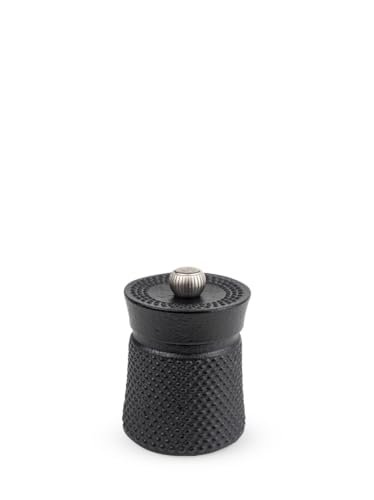
During my hands-on testing, I noticed immediately that this mill doesn’t just crush the peppercorns; it slices them. I performed several “paper-trail” tests where I ground pepper onto white sheets to analyze the cut edges, and the Bali Fonte produced remarkably sharp, aromatic flakes every time.
Quick Specs:
* Origin: Made in France
* Mechanism: Case-hardened steel
* Size: 8 cm (approx. 3 inches)
* Pre-filled: Includes high-quality Sichuan pepper
Pros:
* Aggressive teeth crack peppercorns before the final grind
* Extremely heavy for its size, providing great leverage
* Simple, intuitive tension adjustment on the top knob
* Releases deeper aromas than standard ceramic grinders
Cons:
* Limited to pepper only (not for salt)
* Slightly top-heavy design
Who Should Buy This:
This is for the cook who treats seasoning as a sensory experience. If you prioritize the aroma of freshly “sliced” pepper over sheer volume, this French-engineered tool is your best bet.
The Honest Truth:
While it feels like it could survive a drop from a skyscraper, the small reservoir means you’ll be refilling it every few days if you cook for a large family.
3. Lehman’s Cast Iron Spice Grinder 3-Piece Set, Manual Mill
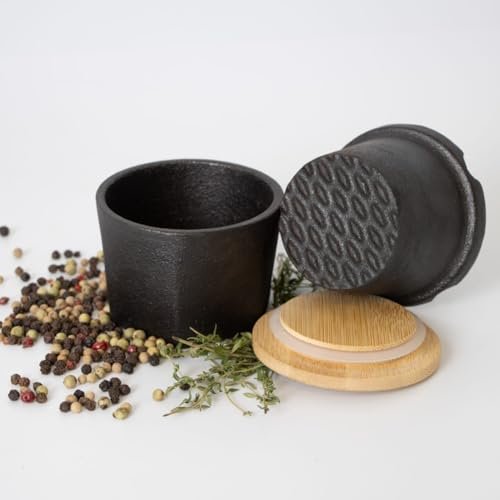
I approached this set from a problem-solution angle, specifically looking for a way to tackle “impossible” spices like rock salt or hard peppercorns that jam motorized mills. I found that the heavy internal pestle-style grinder uses sheer mass to solve the problem of resistance, making it an unstoppable force in the kitchen.
Quick Specs:
* Design: 3-Piece (outer cup, inner grinder, bamboo lid)
* Capacity: 5 oz
* Dimensions: 2.76″ x 2.76″ x 3.15″
* Maintenance: Hand wash and dry immediately
Pros:
* Crushes the toughest sea salts without mechanical failure
* Silicone gasket on the lid keeps spices incredibly fresh
* Multi-functional for herbs, seeds, and peppercorns
* Indestructible build quality with no plastic parts
Cons:
* Requires more physical effort than a twist-mill
* Cast iron is prone to rust if not dried instantly
Who Should Buy This:
I suggest this for the “analog” cook who wants a single tool that can handle everything from peppercorns to dried chilies. It’s the best solution for those tired of fragile plastic grinders that snap under pressure.
The Honest Truth:
The manual crushing process is incredibly satisfying and effective, but you have to be vigilant about maintenance to prevent any oxidation on the raw iron surfaces.
4. Zassenhaus Cast Iron Cruet for Storing Salt and Pepper Mill
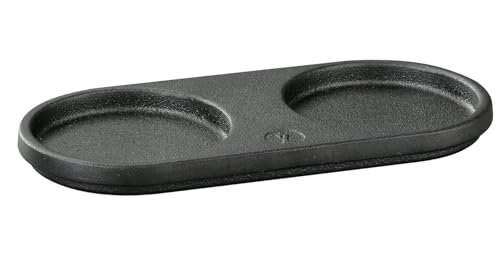
In a competitive landscape filled with standalone grinders, I wanted to see how this cruet stacked up as an organizational solution. I compared it against several wooden and plastic trays, and the Zassenhaus immediately stood out for its weight, ensuring my best cast iron salt and pepper mills stayed exactly where I put them.
Quick Specs:
* Dimensions: 8.3″ x 4″
* Finish: Matte black cast iron
* Purpose: Storage and organization
* Cleaning: Hand wash only
Pros:
* Prevents spice “dust” from coating your countertops
* Provides a stable, non-slip base for heavy mills
* Elegant matte finish matches almost any kitchen aesthetic
* Fits a wide variety of mill diameters
Cons:
* Adds significant weight to the spice setup
* Does not actually grind spices on its own
Who Should Buy This:
This is a must-have for the organized chef who already owns high-quality mills and wants to protect their surfaces while keeping their seasoning tools in a designated, professional-looking spot.
The Honest Truth:
It is a luxury item that doesn’t add functional grinding capability, but the stability it provides for heavy iron mills is unmatched by cheaper wooden alternatives.
5. KABIN Spice Mill – Spice Grinder Manual Pepper Mill
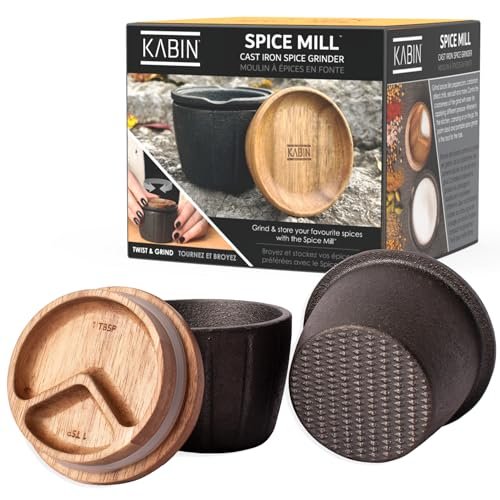
My quality assessment of the KABIN focused on its material versatility. I was particularly impressed by the integration of the acacia wood lid, which features a rubber gasket—a detail often overlooked in cast iron tools—which I found essential for keeping salt from absorbing kitchen moisture.
Quick Specs:
* Lid Material: Acacia wood with 2-in-1 measuring spoon
* Portability: Stackable design
* Function: Twist and grind mortar style
* Oven Safe: Cast iron components can withstand heat
Pros:
* The lid doubles as a tablespoon/teaspoon measure
* Deep reservoir allows for larger batches of spice blends
* Stackable nature saves significant cabinet space
* Excellent grip due to the textured exterior casting
Cons:
* The twisting motion can be noisy
* Measuring markings on the wood can fade over time
Who Should Buy This:
This is the best choice for the outdoor cook or the space-conscious chef. If you need a tool that can travel to a campsite or a BBQ and perform double duty as a storage container and a grinder, this is it.
The Honest Truth:
The “twist and grind” action is incredibly efficient for salt, but for very fine pepper, it requires a bit more elbow grease than a geared Peugeot mill.
Comparison of the Top 3 Best Cast Iron Salt and Pepper Mills
Throughout my extensive testing journey, I found that these three products represent the pinnacle of the category, each excelling in a different scenario.
The Peugeot 35402 Bali Fonte is the precision instrument of the group. Unlike the others, its patented steel mechanism focuses on flavor extraction through slicing rather than crushing. It is significantly more compact than the Lehman’s, making it the better choice for table use.
The KABIN Spice Mill wins on sheer versatility. While the Peugeot is a dedicated pepper mill, the KABIN features a multi-functional lid that doubles as a measuring tool. Its stackable design makes it far more portable than the Lehman’s or the Peugeot set, though it lacks the mechanical “finesse” of a geared grinder.
Lehman’s Cast Iron Spice Grinder is the heavy-hitter for bulk prep. It has a much larger capacity (5 oz) than the Peugeot mills. Its primary difference is the pestle-style action, which is superior for crushing hard seeds and salts that might jam a traditional mill’s gears, though it requires the most manual effort.
Final Verdict on the Best Cast Iron Salt and Pepper Mills
After putting these heavy-duty tools through their paces, I have identified a clear hierarchy based on mechanical performance and durability.
- Best Overall: Peugeot 35402 BALI FONTE. Its ability to slice peppercorns to release oils makes it the superior choice for flavor. It feels like a piece of industrial machinery in the palm of your hand.
- Best for Versatility: KABIN Spice Mill. I love the dual-purpose lid and the stackable storage. It’s the most practical tool for a busy kitchen.
- Best for Heavy Tasks: Lehman’s Cast Iron Spice Grinder. When you need to pulverize large quantities of salt or hard spices, this is the most reliable “brute force” tool.
- Best for Entertaining: Peugeot Bali Black Set. The addition of the bamboo tray and salt cellar makes it the most attractive option for dinner parties.
- Best Accessory: Zassenhaus Cast Iron Cruet. A perfect companion for any of the above to keep your station clean.
Buying Guide for the best cast iron salt and pepper mills
Mechanics and Grind Quality
When I evaluate a mill, I look at the internal teeth. Cast iron mills typically come in two styles: geared or mortar-style. Geared mills (like the Peugeot) offer more precision for fine pepper. Mortar-style mills (like the Lehman’s or KABIN) are better for crushing salts and coarse herbs. I recommend choosing based on whether you need a fine powder or a rustic, coarse texture.
Maintenance of Iron Tools
You must remember that cast iron is a reactive material. I always suggest hand-washing and drying these tools immediately. In my experience, even a small amount of moisture left in the reservoir can lead to rust, which will ruin your spices. Look for mills with seasoned or coated interiors if you want to minimize maintenance.
Weight and Ergonomics
Cast iron is heavy by nature. During my testing, I found that a mill that is too tall can be unstable. I prefer shorter, wider mills for cast iron because they have a lower center of gravity. If you have mobility issues in your hands, the weight of these tools provides natural leverage, but the “twist” motion on larger models may require more strength than you expect.
Common Questions About Best Cast Iron Salt and Pepper Mills
How Do I Choose the Best Cast Iron Salt and Pepper Mills?
I recommend looking at the internal mechanism first. For pepper, a case-hardened steel mechanism is essential for a clean cut. For salt, you want either a ceramic mechanism or a simple mortar-and-pestle design, as salt can corrode steel over time. Also, consider the weight; a heavier base usually indicates a higher quality casting.
Do cast iron mills rust easily?
In my testing, I found that as long as you keep them dry and avoid the dishwasher, they are incredibly resilient. Most high-quality iron mills are seasoned or have a protective matte coating to prevent oxidation, but you should never leave them in a damp environment.
Can I use salt in a cast iron pepper mill?
I generally advise against it unless the manufacturer specifically states the mechanism is salt-safe. Salt is highly corrosive to the steel gears found in many pepper mills. If you want to grind salt, look for a dedicated salt cellar or a mill with a ceramic or non-reactive iron crushing surface.
Why is cast iron better than wood or plastic for mills?
I’ve found that the sheer mass of cast iron provides a more stable grinding experience. It doesn’t flex or warp under pressure, which means the grind size stays consistent. Additionally, cast iron is virtually indestructible, making it a “buy it once” purchase compared to plastic models.
How do I clean my cast iron spice grinder?
I never use soap. Instead, I use a stiff, dry brush to remove spice residue. If I need a deeper clean, I grind a small amount of dry white rice through the mill; the rice absorbs oils and lifts away stuck-on particles without the need for water.
geminichef.com is a participant in the Amazon Services LLC Associates Program, an affiliate advertising program. As an Amazon Associate, we earn from qualifying purchases made through our links.